

.Biography
"Rose has many virtues as a performer, but if we were obliged to highlight just one of them, that would be the elegance."
Scherzo
After having performed on stages of established prestige like the Konzerthaus Viena, the Laeiszhalle and the Elbphilharmonie Hamburg, the Teatros del Canal and the Auditorio Nacional Madrid, the Gran Teatro of Bogotá, the Quirinale in Rome, the Teatro Ponchielli of Cremona, the Zaryadye Hall of Moscow or the Topcapi Palace of Istanbul, Johanna Rose has aroused the interest of the international press, who coincide in describing her as a performer of great virtuosity and sensitivity:
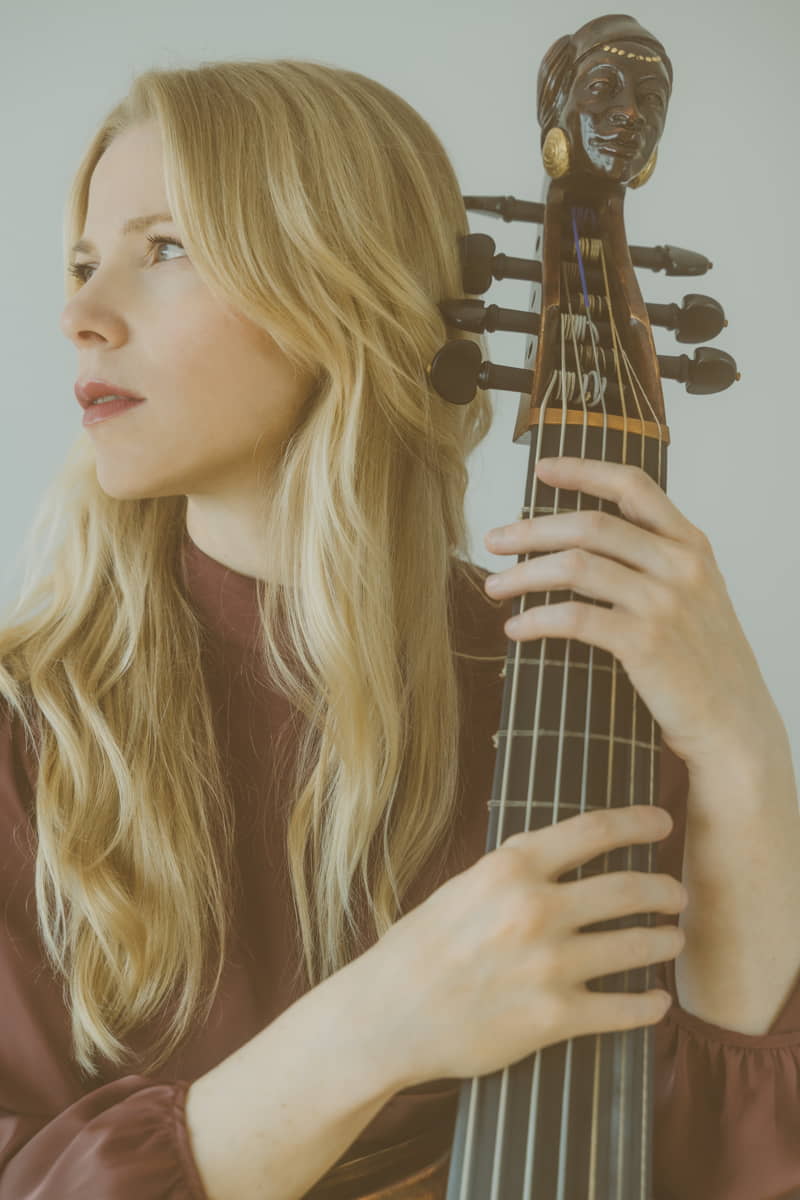
“The sound that Johanna Rose extracts from her instrument is overwhelming, powerful and delicate at the same time, full of force and sensitivity. She is a discovery and is certainly at the beginning of a great international career.”
SR KulturRadio
“Her interpretation is charactarized by a great technique, but above all by a degree of musicality in which she is in no way inferior to the great masters of older generations.”
Klassik Radio Viena

Her concerts have been broadcast live from important radio stations such as Radio Nacional de España, Rai 3, WDR 3 or Bayrischer Rundfunk.
“Almost intoxicating virtuoso scales and triad breaks on the viola went hand in hand with absolute rhythmic clarity in Johanna Roses’ playing. There was magical dinamic lighting, exciting tempo shifts of the finest kind.”
Weser Kurier Bremen

“Deliciously contemplative… a fine recital”
BBC Radio 3 Record Review
Johanna Rose has collaborated with groups like Il Pomo d’Oro, Constantinople (Kiya Tabassian), Tiento Nuovo (Ignacio Prego), La Venexiana, More Hispano, la Orquesta Barroca de Sevilla, la Grande Chapelle (Albert Recasens), Concerto 1700 (Daniel Pinteño), Música Prima, La Bellemont o Forma Antiqua. She has worked under the direction of Rinaldo Alessandrini, Monica Hugget, Maxim Emelyanychev and Carlos Núñez among others. Johanna Rose has been invited by the Hong Kong Philarmonic orchestra to play the Solo Arias of the St Matthew Passion under the direction of Jaap van Zweden. She shares a long career with Accademia del Piacere (Fahmi Alqhai), with whom she has developed an intense activity all over the world: Portugal, Belgium, Germany, Austria, Poland, Switzerland, Panama, South America, The United States and Japan. Rose has participated in several recordings for the labels Deutsche Harmonia Mundi (Accademia del Piacere), Glossa (La Venexiana and Accademia del Piacere), Carpe Diem (More Hispano), Lindoro (Música Prima), Itinerant (La Bellemont) y Alqhai & Alqhai (Accademia del Piacere). Her first álbum as a soloist (Rubicon Classics 2017), which includes the three sonatas for viola da gamba by Carl Phillip Emanuel Bach, was very favorably received by the specialized press:

“These are beautifully sensitive, expressive and musically shaped performances. All in all, a really strong solo debut.”
Gramophone
With her second work on the same record label, Histoires d’un Ange (Rubicon Classics 2019), dedicated mostly to Marin Marais, she has received three nominations for the prestigious German award Opus Klassik.

“This hour long recital of viola da gamba music is enormously enjoyable, such is the variety of the music, a lively recording, and so well has the program been put together ”
The Strad
In Seville, the town where she finished her studies with Ventura Rico, after having studied in Basel (Paolo Pandolfo), Lugano (Vittorio Ghielmi) and Milán (Rodney Prada and Lorenzo Ghielmi), she develops a wide musical activity that includes experiences such as the founding of her group Sarao de Musas together with the soprano Mariví Blasco - a project based on the intention to combine the research and popularizing of the Spanish Baroque - or the bond with the clarinetist Diego Montes, with whom she forms a unique duo that has attracted the attention of composers such as Hilda Paredes, Gerardo Dirié and Ramón Gorigoitía (premiere in 2019 in the Teatro Central of Seville).
"Wonderful sounds, we should keep an eye on Johanna Rose, or even better – an ear!"
SWR Classic